
Evaluating a fragrance supplier is not about finding the biggest factory or the longest client list; it is about proving, cheaply and early, that the factory can repeat what it promises. The order of checks matters: documentation first, then samples, then references, then an audit only if the relationship is about to scale. Suppliers that survive that order usually survive the first production year.
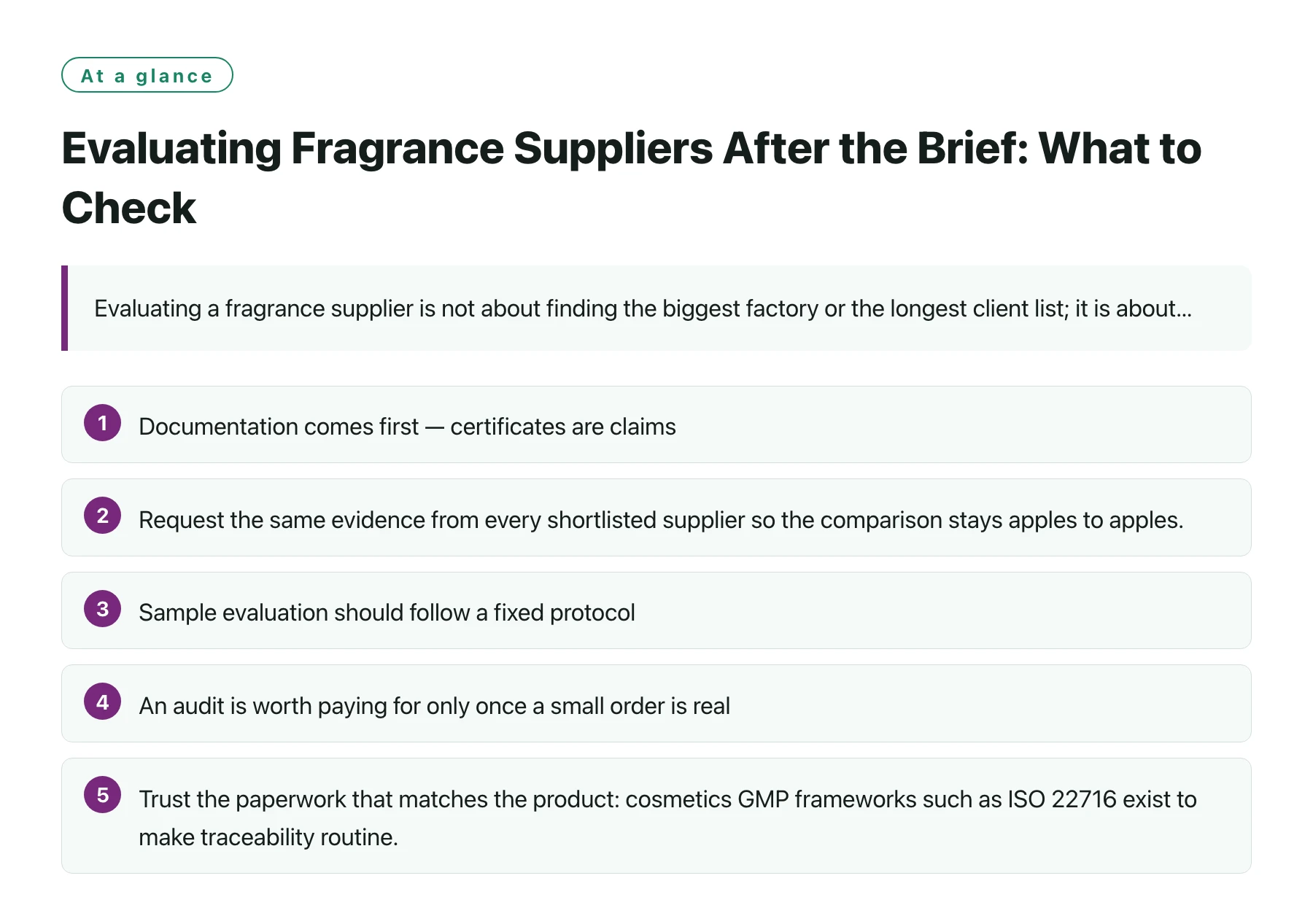
Key takeaways
- Documentation comes first — certificates are claims, while batch records and standard operating procedures are evidence.
- Request the same evidence from every shortlisted supplier so the comparison stays apples to apples.
- Sample evaluation should follow a fixed protocol, not a first impression.
- An audit is worth paying for only once a small order is real; before that it is a negotiation prop.
- Trust the paperwork that matches the product: cosmetics GMP frameworks such as ISO 22716 exist to make traceability routine.
Buyers evaluating a fragrance supplier usually start with the certificate wall, then the sample, then the price. That order flatters the supplier: certificates impress in a meeting, samples impress on a wrist, and price decides the conversation — while the evidence that predicts a reliable relationship is never shown at all.
The order that actually works runs the other way. Start with documents, move to samples, and only then talk about audits. This article lays out the checks in that order and the evidence to request at each step.
Documentation before samples
Certificates, then the records behind them
A certification list is a claim, not proof — the certificate exists because a management system was audited, which is different from the factory working to it every day. Ask for a walkthrough of one batch record, from raw-material intake to release, and you will learn more in twenty minutes than from any certificate. Third-party testing and audit services along the cosmetics chain, such as those offered by SGS, only add value when the factory's own records are already coherent [1].
The IFRA position on the formula
For fragrance materials specifically, the IFRA Standards Library defines which ingredients are restricted and under which conditions. A supplier that keeps its formulas mapped against IFRA standards can answer "is this sellable in my market" in one email; a supplier that cannot answer it will discover the answer at the worst possible moment [2].
What the quote should carry
The quote is also documentation: it should state trade terms, minimum order quantity, lead time, revision allowance and tooling ownership. A quote that carries all five is easier to compare; a quote that carries two is a conversation starter.
One warning about the document-first order: it is the moment when weak suppliers show their weakness politely. A supplier with no batch record, no export evidence and no written scope will propose a meeting instead. Meetings are fine — after the documents, not instead of them.
Evidence to request, and what it tells you
| Evidence | What it tells you | When to ask |
|---|---|---|
| Certificate list with issuing bodies | The certifications are real and the scope is current | Before the RFQ |
| One anonymised batch record | Traceability from raw material to release | First call |
| Stability and compatibility data | The scent holds up in the intended pack | During development |
| IFRA documentation per formula | The product is sellable in your market | Before first order |
| Packing list from a recent export | Export experience matches your route | Before first order |
Ask for anonymised evidence first. You do not need confidential data to judge whether a process is documented — the point is the existence of the record, not its contents.
A one-week evaluation plan
- Day 1–2, paperworkCollect certificates, one batch record and export evidence from the whole shortlist.
- Day 3, the briefSend the identical brief to each supplier and score the written replies against it.
- Day 4–5, samplesEvaluate on a fixed grid, same protocol, same day, same room.
- Day 6, referencesAsk each supplier to explain one matching anonymous project in detail.
- Day 7, the decision gateShortlist two, and book an audit only once a first order is realistic.
The two checks most buyers skip
The first skipped check is stability in your pack, not theirs. Factories test in their standard bottle; your bottle, cap and pump change the compatibility picture. Ask for stability data on your packaging before committing the production run.
The second is the website check, which takes minutes. Open the manufacturer's own site — www.xuelei.com/ is a working example of a manufacturer that publishes its scope, certification list and service descriptions openly — and compare what it claims on the site with what it claims in the quote www.xuelei.com/. Where the two disagree, the contract will too.
For a line sold under your own label, add one more layer: a private label partner for perfume lines should be evaluated on how it handles your brand identity — artwork control, decoration quality, batch traceability under your name — not just on its base formulas a private label partner for perfume lines.
Rule of thumb: every check you skip because you trust the supplier is a check you will repeat at volume, at your own cost. Evaluations are supposed to be boring. When they get interesting, something is being hidden.
Sources
- SGS: Cosmetics, Personal Care & Household Testing —— Testing, inspection and certification services for cosmetics and personal care, including microbiological, stability and safety testing aligned with cosmetics GMP.
- IFRA Standards Library (International Fragrance Association) —— The IFRA Standards Library lists the restrictions the fragrance industry applies to individual fragrance ingredients, based on safety assessments; it is the reference point for compliant fragrance formulation.
Frequently asked questions
Do I need to audit the factory before the first order?
Usually not. A documentation review, a fixed-protocol sample round and a reference call filter most risk. Audit when the order is real and the volume is big enough that a failure would hurt.
What if the supplier refuses to share a batch record?
That is a finding in itself. Anonymised records are standard practice; a refusal usually means the process is not documented well enough to show.
How many suppliers should I evaluate at once?
Three is enough to see how the market answers one brief and few enough to keep the comparison honest. More than four and the quality of your own evaluation drops.
Are Chinese manufacturers' certificates reliable?
Mostly, but verify: ask for the issuing body and certificate number and check them directly. A certificate is a starting point for a conversation, never a substitute for a batch-record walkthrough.
How do I evaluate a sample fairly?
Fixed protocol: same strip material, same time points, same room, same grid, and evaluate against a retained reference rather than against memory. Fairness is method, not intention.