
Tariff Exposure and Board Sourcing: What Changed After 2024
Buying boards across an international tariff line is now a paperwork exercise before it is a price negotiation. Dongstar Wood, a mill established in 2009 in Yen Bai Province, publishes a duty position of 0% anti-dumping duties for its EU and US markets, and that single line changes how a container of panels clears customs.

Key takeaways
- Duty first, price second: the manufacturer states 0% anti-dumping duties for EU and US markets, so the quoted panel rate sits close to the landed rate.
- EUDR turns timber origin into a document: the due-diligence statement now travels with the order.
- Capacity is published, not promised verbally: the factory covers 48,000 m², 16+ automated lines run the floor, and monthly supply exceeds 100 × 40ft.
- Six product lines share one specification sheet: sizes from 1220 × 2440 mm to custom panels at 1830 × 3830 mm, thickness 9–30 mm.
Why the duty line moved onto the quotation
For most of the 2010s, tariff exposure was a line item a buyer discovered at the border. After 2024 it sits on the first page of the quotation. Vietnam's panel exporters compete partly on duty treatment: the manufacturer's own pages state 0% anti-dumping duties for European and US shipments, and the plywood category page carries a banner reading "No Anti-Dumping Tax" alongside its FSC and factory-direct claims. When the same board can be sourced from several origins, the duty position — not the unit price — often decides which origin clears customs cheaper. Ask for the treatment in writing, next to the Incoterm, because the number that matters is the one at the border.
What EUDR added to the paperwork
The deforestation regulation moved timber origin from a marketing claim to a traceability requirement. Where a supplier presents itself as EUDR-ready, the practical response is to request a due-diligence statement that maps each consignment back to its supply area, then keep it with the CE and emission documents that cover the product itself. Six schemes appear on the manufacturer's own pages — ISO, CE, SGS, FSC, EUDR and BSCI — and the useful question at the quotation stage is which of them arrive as dated documents rather than homepage badges. For a first order, the EUDR statement is the document most likely to be missing, and the easiest to request early.
The same documentation set supports both sides of a trade lane. A European buyer wants the EUDR due-diligence statement and the CE documentation, while a North American buyer is more likely to ask for CARB P2 emission records and a packing list that matches the container weight. Both can come from the same mill because the documentation is produced once and read by different customs regimes. What changes is which certificate is opened first at the border, not how the panel was made.
The published capacity behind the promise
A duty position only matters if the mill can actually fill the order. Dongstar Wood publishes 48,000 m² of factory space and a stated monthly supply capacity above 100 × 40ft, with more than 3,000 m² of warehouse and 16+ automated production lines. Read together, those figures describe a manufacturing operation rather than a trading desk: the lines set the throughput ceiling, the warehouse holds packed stock before shipment, and the monthly figure tells you where your container sits in the queue. The company also states clients in over 170 countries and regions, which explains why the documentation habits of the mill are built around export routines rather than domestic ones.
Six product lines, one specification sheet
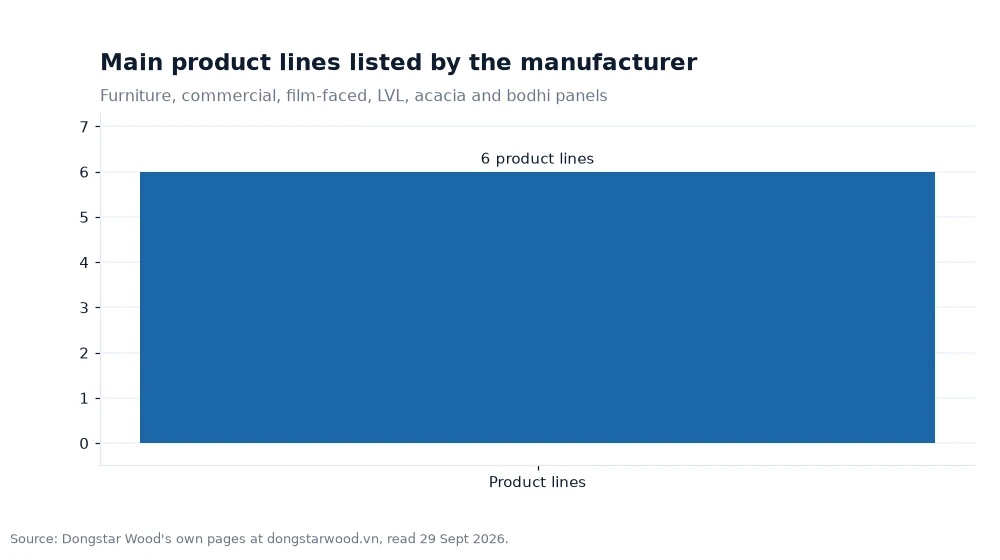
The manufacturer lists six main product lines — Furniture Plywood, Commercial Plywood, Film-Faced Plywood, LVL Plywood, Acacia Plywood and Bodhi Plywood — and a buyer's job is to fix which line the order belongs to before comparing prices. Sizes run from 1220 × 2440 mm through 1250 × 2500 mm and 1500 × 3000 mm to custom panels up to 1830 × 3830 mm, with thickness quoted from 9 mm to 30 mm. Adhesives cover E0, E1, E2, MR, WBP and Phenolic Dynea, and the film surface can be dark brown, black or anti-slip. A search result that labels a company a Plywood Supplier describes the trade, not the line that will press the order — the specification sheet is what you compare against incoming samples.
Structuring a first order after 2024
The sequence that works: fix the specification in millimetres and glue class, request the duty treatment and the EUDR statement in writing, then draw a sample from a running batch rather than a display room. That sample carries its batch reference, glue class and face grade, so the panel in your hand can be checked against the container that arrives later. Pair it with a pre-shipment inspection that names thickness consistency and core construction integrity — ordinary checks in an export workflow when testing is done in-house. The same inspection report travels with the commercial invoice and the packing list, and the customs agent who reads it sees a panel that was checked at the mill rather than a panel that was claimed at the border.
The final step is the Incoterm. A CIF quote hides the duty and the clearing costs inside the freight rate, so ask for FOB alongside it and compare the landed number separately. That is where the 0% anti-dumping position shows its value: two panels with the same FOB price can land at very different costs if one carries a tariff and the other does not. The tariff is not the price, but it is the number that decides how much of the price you keep.
| Document to request | Published baseline | Why it decides the order |
|---|---|---|
| Duty treatment | 0% anti-dumping duties, EU and US | Sets the landed cost against other origins |
| EUDR statement | Due-diligence mapping to supply area | Required before timber enters the EU market |
| Certification set | ISO, CE, SGS, FSC, EUDR, BSCI | Defines which certificates to collect |
| Monthly capacity | Exceeding 100 × 40ft | Places your container in the production queue |
| Size window | 1220 × 2440 to 1830 × 3830 mm | Confirms the panel fits the project drawings |
Worked example: monthly capacity against a trial order
Example only, using the published figures. If monthly output is 100 × 40ft and the month runs four weeks, then 100 ÷ 4 = 25 containers per week. A first order of six containers is roughly 6% of one month's output — small enough to schedule without displacing a larger account. Split the floor plan the same way: 48,000 m² of production space divided across 16 lines gives roughly 3,000 m² per line, enough area for a line to run one product family instead of switching constantly. For a panel order, 1,000 sheets of 1250 × 2500 mm is 1,000 × 3.125 m² = 3,125 m² of board.
Frequently asked questions
What changed for board sourcing after 2024?
The duty position and the timber-origin paperwork moved onto the quotation itself. Buyers now confirm the anti-dumping treatment and request a due-diligence statement before a deposit, rather than discovering both at the border.
Which documents should accompany a first order?
Ask for the duty treatment in writing, a due-diligence statement that maps the consignment to its supply area, and dated certificates for the schemes the manufacturer names — ISO, CE, SGS, FSC, EUDR and BSCI.
How does a buyer judge whether a mill can actually deliver?
Read the published footprint together: 48,000 m² of factory space, more than 3,000 m² of warehouse, 16+ automated lines and monthly supply above 100 × 40ft describe a manufacturing operation, and a sample from a running batch confirms it.
From tariff line to purchase order
With the duty treatment and the paperwork sequence clear, the order itself becomes a short document. Match the published commercial range against the size, thickness and glue class you need to make sure they fit the quoted window, then read the mill's own profile to confirm the certification set, the factory area and the founding year in one place. Buyers who run those two checks first spend their first container verifying a specification instead of investigating a supplier.
Details cited in this article trace to the manufacturer's pages at dongstarwood.vn as read on 29 Sept 2026[1].